

 English
 русский
 Español
 عربى
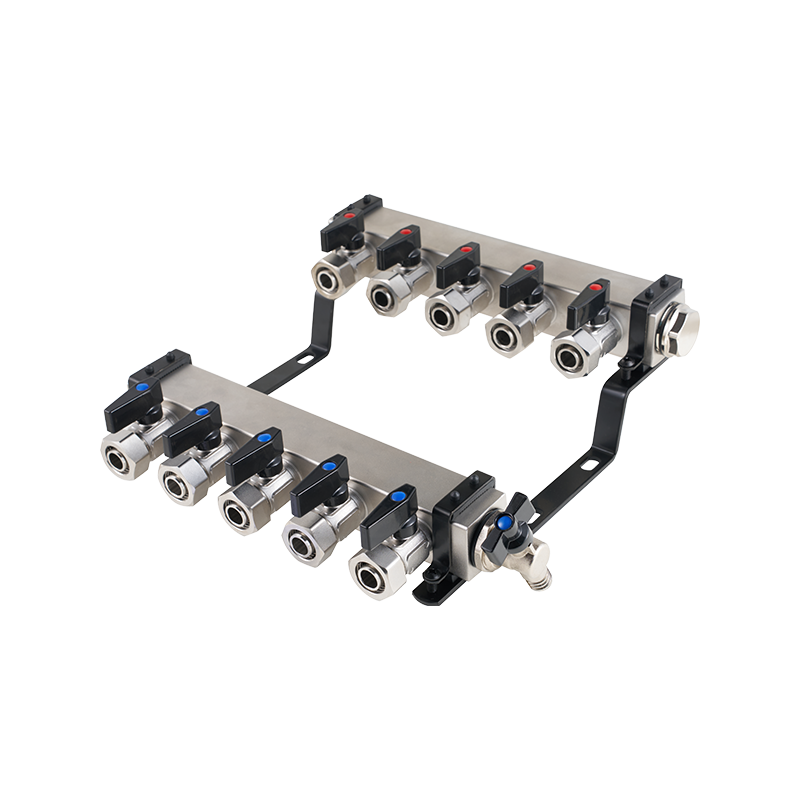
A hydronic underfloor heating system depends on secure connections and stable water circulation throughout its pipework. Because the manifold brings multiple heating circuits together, a problem at one connection can affect commissioning, maintenance, and the reliability of the complete installation. For buyers sourcing a Floor Heating Manifold, understanding how sealing structures, component accuracy, and manufacturing inspections work together is essential. Preventing leakage problems begins before installation, with appropriate product design, controlled assembly, and clear technical requirements.
Connection Design Is the First Line of Defense
A manifold contains several connection points for supply lines, return lines, and individual heating circuits. Each connection must match the intended pipe system and provide a suitable sealing arrangement.
Manufacturers should consider connection dimensions, thread accuracy where applicable, sealing surfaces, and compatibility with the specified fittings. Buyers need to confirm connection types and sizes before ordering, especially when the manifold will be integrated into an existing heating installation. A connection that appears similar may not provide the correct fit if its dimensions or sealing method differ.
Sealing Components Require Careful Selection
Seals and gaskets help prevent water from escaping at designated connection points. Their suitability depends on the material, operating temperature, pressure conditions, and the design of the mating surfaces.
During product development, manufacturers should select sealing components that match the intended service conditions. They should also establish clear assembly requirements so seals are correctly positioned and are not damaged during installation. For procurement teams, reviewing the specified operating limits and replacement guidance can help determine whether the product fits the intended application.
Component Accuracy Supports Reliable Assembly
Even suitable materials may not produce a dependable connection if the mating components are poorly manufactured. Dimensional variation, damaged threads, rough sealing surfaces, or misaligned parts can complicate assembly and increase the possibility of leakage.
A Floor Heating Manifold manufacturer should pay attention to critical dimensions throughout production. Depending on the product construction, inspection may include:
- Checking connection dimensions and thread condition
- Inspecting sealing surfaces for visible defects
- Verifying the fit of valves and connection components
- Checking the placement and condition of seals
- Confirming assembly alignment
- Reviewing the finished unit for visible damage
These checks help identify potential assembly issues before the product leaves the factory.
Pressure Testing Should Follow Defined Requirements
Visual inspection alone cannot confirm that a manifold assembly is leak-free under the required test conditions. Pressure testing provides a way to assess the integrity of the assembled product using a defined procedure.
Manufacturers should establish test conditions appropriate to the product design and applicable requirements. The process should specify the test medium, pressure, duration, acceptance criteria, and inspection method. Test results should be recorded consistently so that products can be assessed against the same requirements.
Buyers can ask what inspection and pressure-testing procedures are applied to the selected model. The purpose is to understand the verification process rather than assume that every manifold is tested under identical conditions.
Installation Practices Also Affect Leakage Risk
Factory quality is important, but the installation process remains a separate factor. Incorrect fittings, unsuitable sealing materials, excessive tightening, damaged threads, or poorly supported pipework may create problems even when the manifold has passed its factory inspection.
Installers should follow the product instructions and use compatible components. Connections should be tightened according to the specified method rather than relying on excessive force. Before the system is concealed or placed into normal operation, the completed installation should be inspected and tested according to the project requirements.
Documentation Helps Buyers Verify Product Suitability
For wholesale and project purchasing, clear technical documentation supports both product selection and installation planning. Buyers should be able to identify the manifold configuration, connection specifications, operating limits, material information, and relevant test requirements.
Manufacturers can improve procurement efficiency by maintaining consistent product drawings, inspection records, installation instructions, and model identification. When specifications are clearly defined before an order is confirmed, both parties have a common reference for evaluating the delivered products and addressing any deviations.
Reliable Manifold Supply Begins With Controlled Manufacturing
A dependable Floor Heating Manifold relies on coordinated decisions about connection geometry, sealing materials, assembly accuracy, and product verification. No single inspection step can replace a complete quality-control process, and correct installation remains essential to the performance of the finished heating system.
For overseas distributors and project buyers, discussing operating conditions, pipe compatibility, connection requirements, and testing documentation before purchasing can reduce uncertainty. As a manufacturer, maintaining defined production specifications and repeatable inspection procedures helps support consistent product quality and gives buyers a clearer basis for selecting a manifold for their hydronic underfloor heating projects.

 CONTACT US
